 Hirudotherapy is a treatment using medical leeches. This kind of therapy is known from the time of extreme antiquity and is still alive nowadays. This fact testifies its efficiency in healing various kinds of illnesses and diseases. The method of hirudotherapy is approved by many countries.The enormous experience of using medicinal leeches in medical purposes is saved up during many centuries. With the development of science the mechanism of action of a secret of salivary glands of leeches was deciphered, biologically active substances which are included in it were opened,their influence on the certain structures of an alive organism is investigated. Some medical forms are created on a basis of biologically active substances of salivary glands of leeches and work on creation of new substances is conducting. Modern hirudotherapy differs from the ancient one because now we do not use wild leeches: instead we use leeches grown at special biofactories where they are in a severe quarantine. Besides, nowadays we use a leech only once. This fact completely excludes the chance of infecting a patient.
Saturday, January 10, 2009
Hirudotherapy
Hirudotherapy is a treatment using medical leeches. This kind of therapy is known from the time of extreme antiquity and is still alive nowadays. This fact testifies its efficiency in healing various kinds of illnesses and diseases. The method of hirudotherapy is approved by many countries.The enormous experience of using medicinal leeches in medical purposes is saved up during many centuries. With the development of science the mechanism of action of a secret of salivary glands of leeches was deciphered, biologically active substances which are included in it were opened,their influence on the certain structures of an alive organism is investigated. Some medical forms are created on a basis of biologically active substances of salivary glands of leeches and work on creation of new substances is conducting. Modern hirudotherapy differs from the ancient one because now we do not use wild leeches: instead we use leeches grown at special biofactories where they are in a severe quarantine. Besides, nowadays we use a leech only once. This fact completely excludes the chance of infecting a patient.

Doctor Fish

Garra Rufa, a type of small tropical fish, also nicknamed Chinchin Yu, nibble fish or simply doctor fish, are put in hot springs. As they can live and swim freely in at least 43-degree-hot waters, they are naturally used for the treatment of skin diseases in such spas. When placed in the spa, these fish can feed themselves on the dead cells of the human body, since they only consume such cells, leaving the healthy skin of the human body to grow. The whole process is reportedly free of pain. It won't hurt and the bather might feel a pleasant tingling on his or her skin.
Kefir
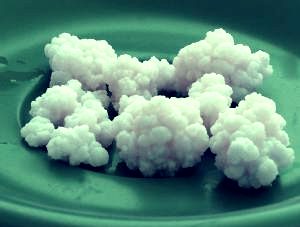
Kefir, (KEE-feer) a cultured dairy product similar in appearance to runny yogurt, is produced through the fermentation of milk with kefir 'grains'. (Above, kefir grains cleaned of their mucous coating.)
The grains, which look like small cauliflower, are a symbiotic combination of bacteria and yeast bound together in (ready?) a gel-polysaccharide bio-matrix. In other words, they're somewhat firm, lumpy, gelatinous blobs held together by big sugar molecules (glucose and galactose).
I'm not sure how the word 'grain' was chosen rather than, say, 'lump,' but kefir has absolutely nothing to do with cereal grains like wheat or oats.
Although still fairly obscure compared to its better-known cousin, yogurt, kefir's popularity is rising steadily. This may have something to do with a growing awareness of its supposed health benefits, which include tumor growth rate reduction, immune system enhancement and the destruction of undesirable bacterial pests in the digestive tract. It's also more digestible than yogurt because its curd size is smaller.
The history of its origins is somewhat vague, but most sources agree its birthplace was the Caucasus mountain region in Eurasia.
One colorful account holds that kefir grains were a closely guarded secret for centuries until Russian dairy owners, using the charms of a beautiful young employee named Irina, and a stern reprimand from the Czar, wrested some from a tribal prince. However it got here, it's a wonderful, if not unusual way to increase the digestibility and health benefits of raw milk.
Numerous strains of kefir exist worldwide, differing mainly in the particular species of bacteria and yeasts which reside within. Both lactic acid and acetic acid producing strains not usually found in yogurt (Lactobacillus caucasus, for instance) team up with yeasts like Saccharomyces kefir and Torula kefir to give kefir its beneficial properties.
Most kefir purists (and they're out there!) insist that the real thing can only be made from real kefir grains. I imagine many suppliers of powdered starter would disagree, but who's to say?
So you want the grains. Where can you find them? Well, unlike the Russian dairymen, you have several more options. Besides doing a websearch, you could go to this site where people from over 40 countries have signed on with their contact info and a willingness to share their grains. Don't forget to come back!
Is it easy to make? Sure, but you need to follow some simple rules to make sure you get it right. Check out any of the several great websites (just Google 'kefir') with detailed instructions on how to do it. You'll be surprised at just how much information there is out there on this tart, refreshing traditional food. I know I was.Kombucha Tea

Kombucha tea is a sweetened tisane produced through fermentation. It has been claimed as the "fountain of youth", but only you can be the judge of such a claim. Plain kombucha has an acidic, vinegar-like flavor in addition to the original sweet tea flavor. The strength of the tea flavor can be adjusted with the amount of tea bags brewed per volume of water. It usually has a mild to moderate carbonated texture. In commercial brands, some have a sweet taste, others do not. This depends on length of brewing time, or if the manufacturer has added sugar to the final product. Kombucha also comes in different flavors. This is usually done by adding juices to the base tea after fermentation/incubation has completed. I'd highly recommend trying different pre-made kombuchas before making it yourself. Kombucha is available at most health food stores, and the organic section of some regular grocery stores.
Subscribe to:
Comments (Atom)